


Lynx copilot. Your superpower, now!
At LynxCraft, we believe that a good house does not have to be an expensive house. We advocate for architecture that is thoughtful, efficient, and carefully tailored to the individual context. We advocate for construction that achieves the best possible balance between cost and performance.
The construction industry is at a turning point. The market will not become transparent on its own. The private investor will not become an expert overnight. LynxCraft establishes a coordination layer that closes this gap, by delivering the right information to the right people at the right time.
The Problem – Private Real Estate Investors’ Projects Cost More and Take Longer!
When you, as a private real estate investor, decide to build your own home, you are embarking on one of the most complex and risky projects of your life. Often, it is only after several months that you begin to realise what is truly happening. You make decisions without sufficient data, choose from contractors you do not know, and negotiate from a position of virtually no bargaining power.

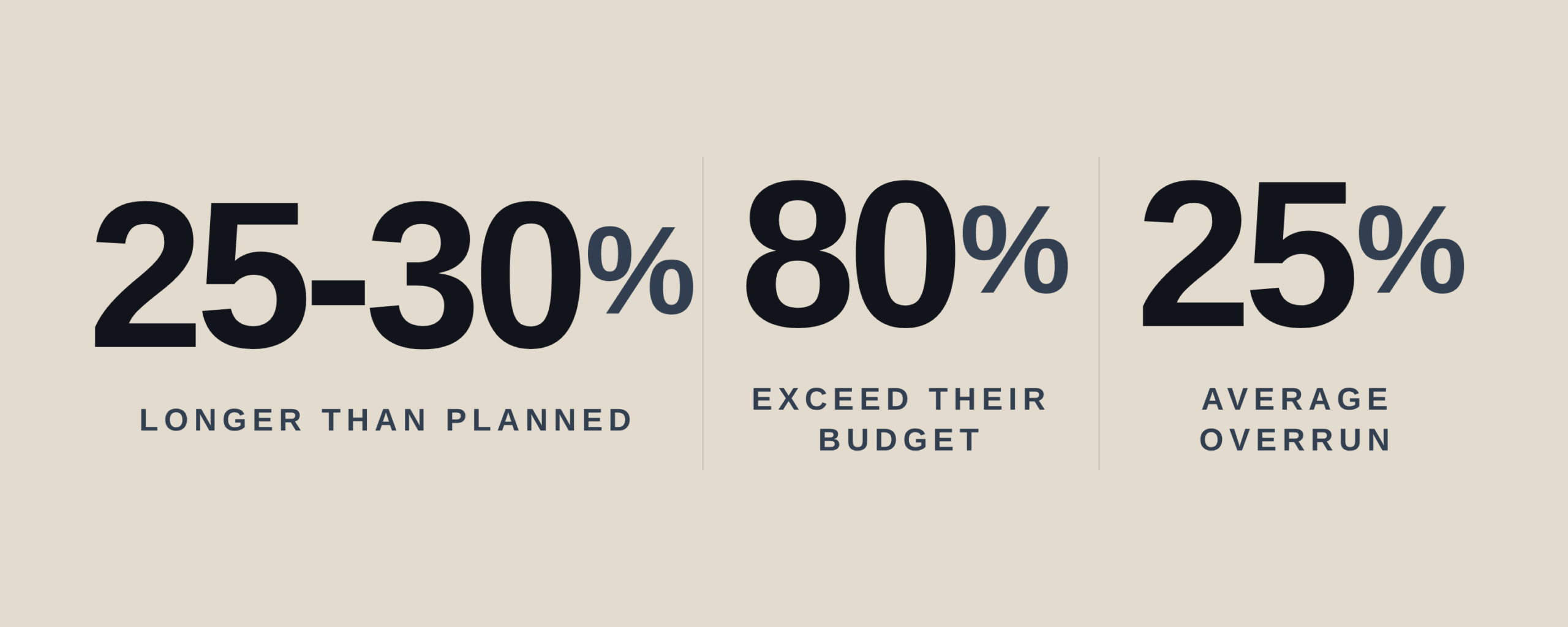
The consequences are predictable. Projects undertaken by private real estate investors take, on average, 30% longer than planned. 80% of all your projects exceed their budget by an average of 25% of the total investment. This is not a coincidence, it is a structural characteristic of a market in which private, non-professional real estate investors manage an extraordinarily complex supply chain of construction contractors, without the relevant knowledge or experience.
A Typical Scenario
When private real estate investors find a plot of land, they hire an architect based on a recommendation. After three months, they receive their first concept design that looks great and appeals to them. Together with the chosen architect, they begin preparing the documentation for a building permit, and this is when the serious costs on the project begin to accrue. After obtaining the planning conditions, and potentially even after an initial rejected building permit application, they discover that the restrictions on the plot do not permit the construction envisioned by the architect, who had not been sufficiently thorough in their analysis. A new round begins. A month of discussions on how to adapt the project. The project is revised, the application is resubmitted, the building permit is obtained, and then comes the shock.
The first rough estimate of the project shows that the construction of the home for which you have just obtained a building permit is 30% over your budget, making it financially unviable. You are left with no choice but to either secure additional funding or revise the concept design of your home once again. In many cases, this requires amending the entire documentation.

When you finally reach the stage of selecting contractors, you encounter the fact that construction companies look very much alike from the outside, they all appear to do the same thing. The critical differences between them are hidden in details that you genuinely do not understand, as you lack the knowledge and experience. You shortlist three that seem, on instinct, to be the best, and ultimately make your decision based on the impression the sales representative made. You compare three quotes that differ by tens of thousands of euros, yet have no tool to help you analyse the differences or determine which quote includes all costs and which does not. You decide by gut feeling.
Six months later, additional works appear. Execution is delayed. Communication goes quiet, followed by chasing contractors and a sense of powerlessness, because as an individual private investor you represent just one of several projects the chosen contractor is working on at that moment. An enormous amount of energy is devoted to coordinating contractors, something that initially seemed like a given, something you assumed you would never need to deal with.
In practice, a private real estate investor’s project, that is the construction of a single- or two-family home, does not represent sufficient motivation for contractors to make a genuine effort and see the project through to completion within the originally agreed parameters. Instead, they attempt to juggle several smaller projects simultaneously in pursuit of maximum profit. Private real estate investors simply do not have the bargaining power to enforce their right to efficient execution.
Regrettably, this is not the exception. This is the standard course of events in the construction of single- or two-family homes.
The Difference Between Large and Small Private Real Estate Investors Lies Not in Ambition, but in Team, Knowledge, Experience, and Bargaining Power.
Large, professional real estate investors employ a professional project management team which coordinates the entire project towards the agreed goals. This gives the investor the knowledge and experience to understand projected costs before committing seriously to the project. The large, professional real estate investor also has existing relationships and prior experience with construction contractors, knowing exactly which contractor is right for a given project. In addition they have strong negotiating leverage, since the volume of repeat business provides sufficient motivation for contractors to respect the agreements. Private real estate investors building your own home typically have none of this. This is a systemic market failure, and it is precisely the gap that LynxCraft addresses.
Three Key Project Challenges for Private Investors
Private real estate investors building your own home currently face three major challenges that professional real estate investors manage with ease.
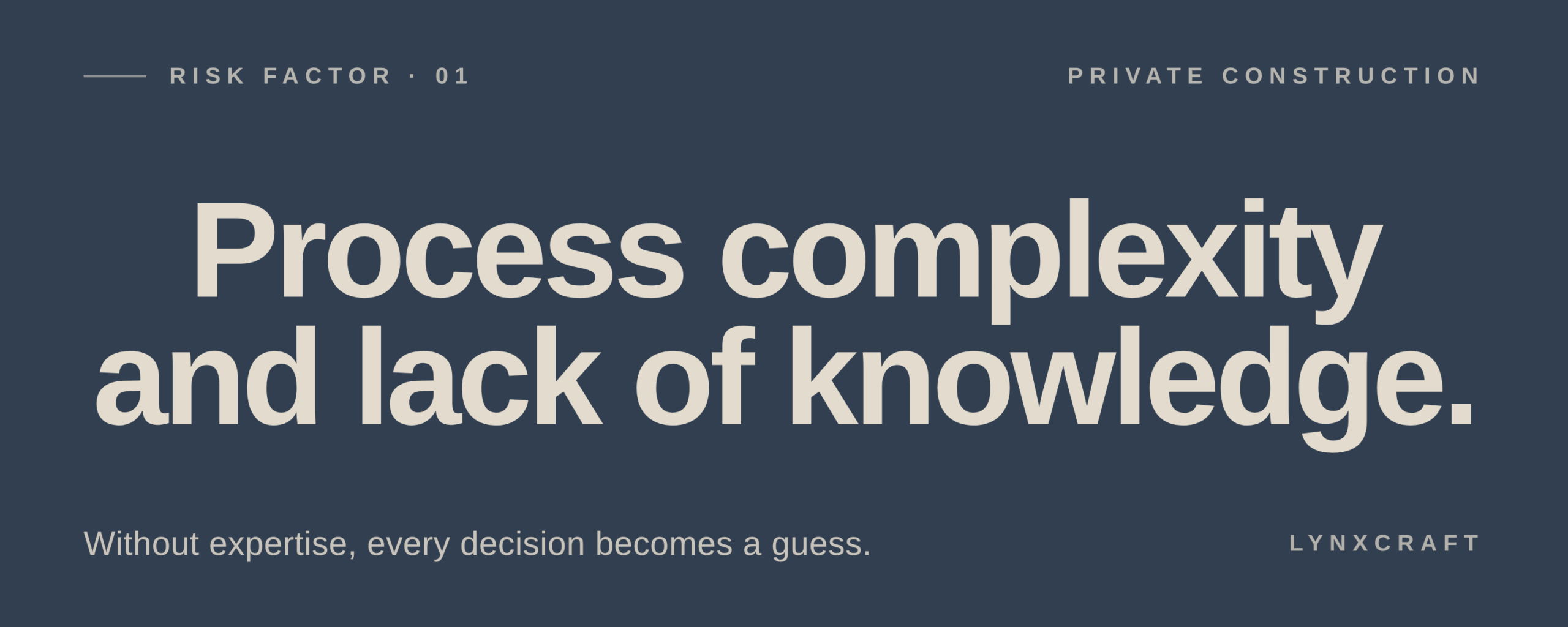
1. Process complexity and lack of knowledge. Building a home is a complex process involving dozens of participants, from architects and engineers to contractors and suppliers. Private investors lack experience in managing real estate projects and therefore struggle to keep track of all the technical details, contractual obligations, and relationships between the parties involved. Without an experienced professional on your side, mistakes go unnoticed for too long, contractors work without adequate supervision, and decisions are made too slowly or based on gut feeling rather than data. The result is a project that does not unfold as planned. In the end, there is nobody responsible for all the mistakes. You are alone!
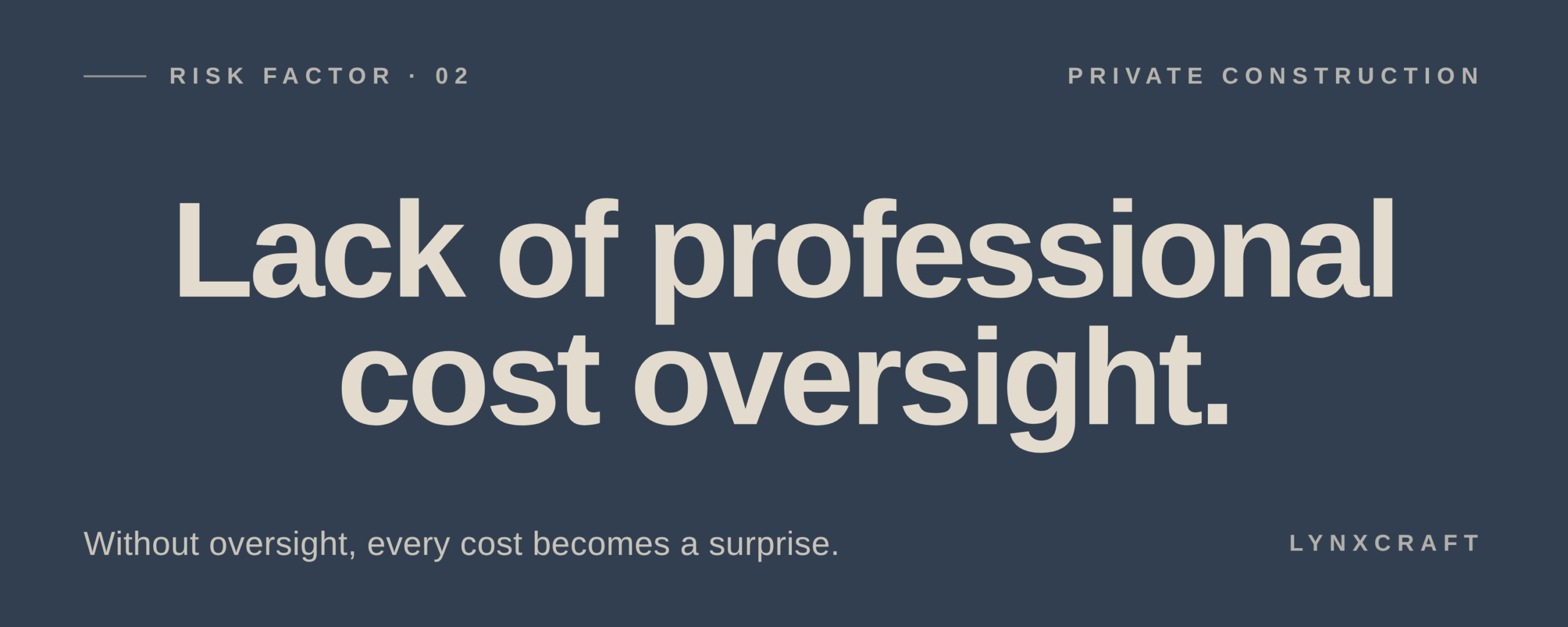
2. Lack of professional cost oversight. Most budget overruns do not arise from a single major mistake, but from the accumulation of small decisions. A change here, a material upgrade there, an additional work item that “just comes up”, each individual decision seems minor, yet together they quickly add up to 30% in additional costs. Poorly defined contracts compound the situation by leaving room for additional claims from contractors. Without someone systematically assessing every change from the perspective of cost, timelines, and consequences, private real estate investors do not see the full picture until it is too late.
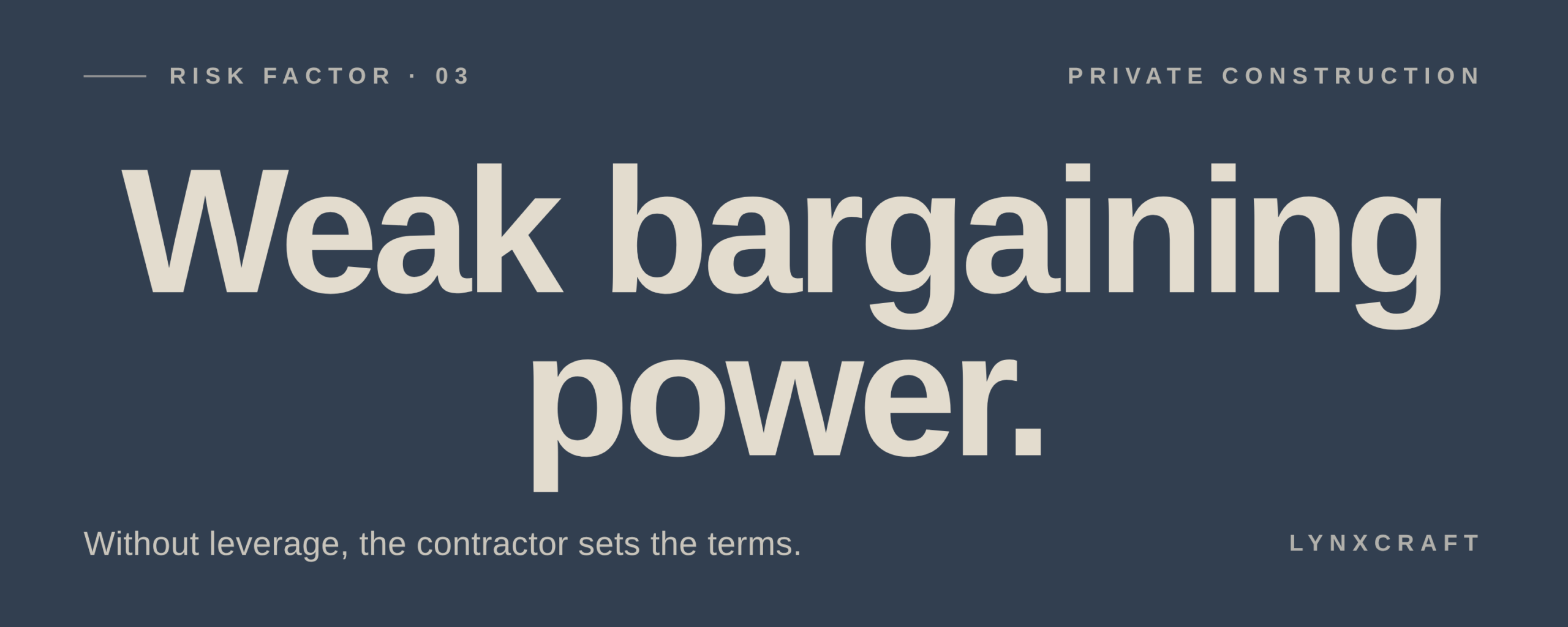
3. The challenge of weak bargaining power in the market. Private investors build your home once or twice in their lifetime, which is not enough for contractors to see you as a serious business opportunity. This is reflected both in the quality of the offers and in the priority given to execution. In addition, a good negotiating position requires precise timing, the decision to sign with a contractor must be neither too early nor too late. Without an experienced professional on your side, you often sign contracts without adequate protective mechanisms, which leaves you in a weak position in the event of disputes, delays, or defects, without support and without a clear legal basis.
The Solution: Lynx Copilot – Comprehensive Support for Private Investors in Efficient Home Construction
Lynx Copilot is the first comprehensive tool focused on private real estate investors who wish to reach youe new home efficiently, without unnecessary stress or complications.
One solution, three system components. Lynx Copilot is built on three components. Each component addresses one specific pain point that currently presents the greatest obstacle for private real estate investors during construction. Together, all three components constitute a revolution for private real estate investors, helping you navigate the entire home construction process efficiently. From the first idea to the moment you move in!
1st Component: Software Based on a Proprietary Construction Algorithm
Why do delays and cost overruns occur on so many projects as early as the concept design stage?
In the early phase of a project, private real estate investors make the most decisions with the least data. You do not know what kind of house can actually be built on your plot. You are not familiar with the spatial planning restrictions. You have no clear idea of what the total investment will actually amount to, not even within 20% accuracy. Every step forward happens by intuition and is essentially a matter of managing a situation created at the outset due to a lack of information.
The first component of Lynx Copilot is proprietary construction algorithm software. The system synchronises three types of data in real time: official spatial data for the plot, local building regulation requirements, and cost parameters.
Based on your preferences and the plot data, it generates a concept design of a house that can actually be built on your plot, together with a comprehensive estimate of the total investment. This design serves as the starting point for preparing a full concept project and all other documentation required for the efficient obtaining of a building permit.
The Lynx Copilot begins this phase with data that is typically only available in a project after six months of work, which, for most investors, is too late to meaningfully adapt the original idea.
2nd Component: Lynx AI Employer`s Representative
What do private investors truly lack for the efficient execution of a home construction project?
The second component of Lynx Copilot is the AI Employer`s Rep / Agent. This is your personal artificial intelligence agent that guides you through the entire home construction process, from the first idea to the handover of the keys. It combines the knowledge of an architect, a supply manager, and a project manager in one solution that works exclusively in your interest, throughout the whole process.

During the concept design phase, the Lynx AI Employer`s Rep / Agent helps you develop a concept design of your dream home that is aligned not only with your wishes, but also with spatial restrictions and your financial capabilities. Based on the plot and your preferences, the system prepares a house design, places the house on the selected plot, generates a 3D visualisation, and produces a comprehensive estimate of the total investment. This is where the greatest shift in power occurs: instead of iterating a single variation, you can iterate as many times as necessary to arrive at the optimal solution. A smaller or larger floor plan. Adjusted room layout. A roof with a different pitch. Each variation takes minutes rather than weeks, and every variation is checked against the budget, spatial restrictions, and practicality. The majority of misunderstandings between private investors and architects arise precisely in these early stages, when a large number of design iterations are needed, iterations that represent a time and financial burden on both sides. With Lynx Copilot, you test variations until you find the one that genuinely works, and only then hand over the concept design to the architect of your choice for professional further development.
During the contractor selection phase, the Lynx AI Employer`s Rep / Agent handles the selection of the most suitable partners for your project. The construction contractor market is highly opaque. Prices vary significantly, references are difficult to verify, and the best option available is typically a recommendation from family or acquaintances, which does not guarantee alignment with the specific requirements of your project. Lynx copilot gives you access to a pool of contractors that have undergone a thorough review in terms of reliability, user track record, and financial stability. Based on the specifics of your project, it recommends a shortlist (typically three) of the most suitable contractors, and compares their offers on the basis of qualifications, actual projects completed, and commercial terms. It clearly identifies which offer represents the best value and flags any potential shortcomings in specific offers. This enables you to make your decision based on data rather than instinct.
During the construction phase, the Lynx AI Employer`s Rep / Agent coordinates all selected partners throughout the entire home construction process. It monitors deadlines. It tracks costs. It alerts you to delays and cost overruns relative to the original plan. It prepares an alternative plan and, on the basis of that plan, coordinates the selected contractors. It formulates the questions you need to ask before the next coordination meeting and reminds you of decisions that need to be made. If an unforeseen situation arises and a contractor anticipates an additional cost, Lynx analyses the situation and tells you whether the additional cost is justified under the original agreement, and if not, how to avoid it. Large investors hire this kind of project manager and pay several thousand euros per month for the service. With the Lynx AI Employer`s Rep / Agent this level of expertise is available to you as well.
3rd Component: Pre-vetted Ecosystem and the Bargaining Power It Brings
Why does an individual always negotiate with contractors from a position of weakness?
The third component of Lynx Copilot is a network of contractors: architects, surveyors, builders, supervisors, interior designers, and other professionals. All have been pre-vetted and qualified on the basis of references, execution standards, financial stability, and other criteria. Their work is monitored at all times by the Lynx Copilot.
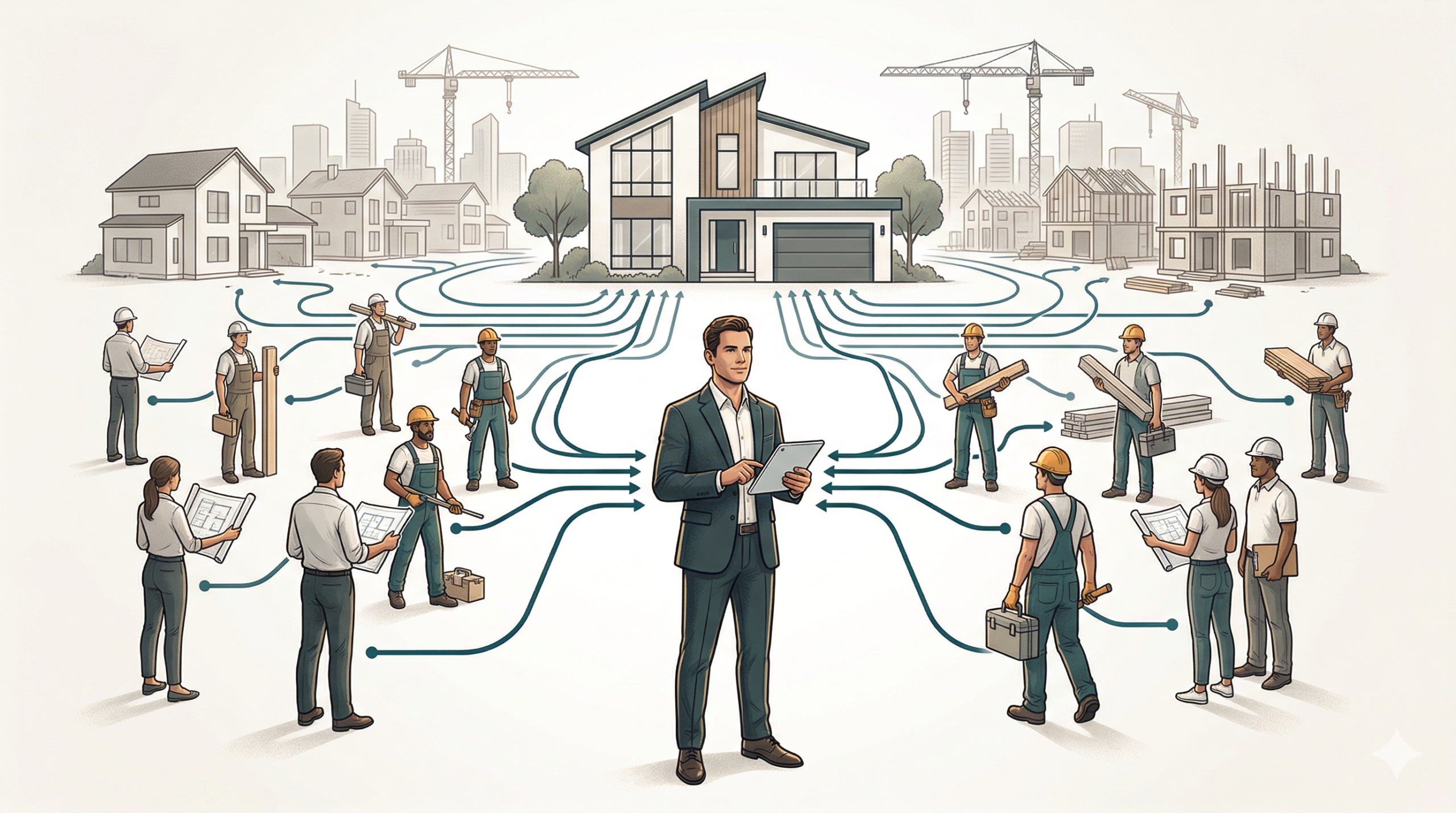
However, the pre-vetted ecosystem is not merely a certified directory of providers. Perhaps even more significant is the power of the collective network. As an individual private investor you undergo the homebuilding process once (maybe twice) in a lifetime. As such you occupy the position of a one-time client in the market, with a correspondingly low level of contractor motivation to treat you as a key account. As a Lynx investor, on the other hand, you hold the position of a major investor, a key account, because behind you stands a larger network of private investors with a continuous flow of projects. This cumulative network represents business opportunities for the entire contractor ecosystem, sufficient for them to try their best to provide premium service to you.
LynxCraft already connects dozens of private investors today, and that number is growing rapidly. We coordinate preferential treatment and commercial terms with contractors, terms that you as an individual one-time investor simply cannot negotiate. In this way, the bargaining power previously reserved exclusively for the largest real estate investors, is built upon the collective strength of the entire group of Lynx investors, and transferred to you, the individual Lynx investor.
The Journey from Plot to Move-In
This is what a project looks like with Lynx Copilot in practice:
- Initial idea design. You enter data about your plot and your preferences regarding the desired home. Lynx Copilot generates a first concept design that is genuinely feasible, together with a comprehensive cost estimate for the entire investment, a photorealistic visualisation, and a depiction of placement on the plot. The concept design takes into account the chosen construction material. At the same time, you gain access to the Lynx AI Employer`s Rep / Agent functionality, which assists you in developing the optimal idea design. This is the phase where the most time and money is typically lost, and where Lynx Copilot delivers the greatest savings.
- Full concept Design. On the basis of the completed idea design, a Lynx-certified architect prepares a full concept project, which serves as thorough groundwork for the efficient preparation of building permit documentation. The full concept design project includes:
- verification of the idea design,
- consultations with a certified Lynx architect,
- official land analysis and construction conditions assessment,
- a fully individualised floor plan,
- professional placement of the house on the plot,
- floor plan layouts, cross-sections, and elevations,
- technical description of the house and its systems,
- additional location data extracts,
- expert guidance and risk analysis,
- a comprehensive cost estimate for the entire investment,
- preparatory groundwork for the building permit documentation phase.
- Selection of an Architect for Building Permit Documentation. The Lynx AI Employer`s Rep / Agent based on the completed full concept design, the investor’s preferences, and the project’s timeline objectives, recommends a number of suitable architects from the pre-vetted ecosystem who, on the basis of references, pricing, and commercial terms, are best matched to the needs of the project. The final selection decision is yours.
- Obtaining the Building Permit. The selected architect obtains official planning conditions, prepares the building permit documentation, and submits the application on your behalf. The reliability and experience of the architect are critical factors in determining the time required to obtain the building permit. There is a widespread misconception that the time required for a building permit application to be approved is determined solely by waiting times at administrative units. In practice, the far more common cause of delays is inadequately prepared applications submitted by the chosen architect. Selecting a high-quality architect is therefore a decisive step in the efficient obtaining of a building permit.
- Technical Documentation for Construction (PZI). On the basis of the completed full design concept and the approved building permit, detailed plans are prepared on which the construction of your dream home will be based. Communication and the exchange of documentation variants/versions is conducted through Lynx Copilot, which verifies consistency with the concept project and alerts you to any unreasonable deviations.
- Selection of Contractor and Construction Supervisor. TheLynx AI Employer`s Rep / Agent based on the completed full concept project, the investor’s preferences, and the project objectives, recommends the most suitable contractors and construction supervisors. The Lynx AI Employer`s Rep / Agent compares line items, flags missing elements or hidden costs, and identifies other irregularities. Pre-drafted collaboration agreements that include preferential commercial terms are available for signing with selected contractors.
- Construction. During the construction phase, the Lynx AI Employer`s Rep / Agent monitors agreed deadlines and costs, alerts you to deviations, coordinates participants, and prepares agenda items for each coordination meeting. At every moment, you know exactly where you stand, both in terms of time and cost relative to the original plan, how much has been spent, and what comes next.
- Interior Furnishing and Move-In (Future Feature). As part of Lynx Copilot, Lynx investors will in the future also be able to select interior furnishings. From concept design to move-in, all within one platform.
- Life in Your Dream Home. After moving into your dream home, Lynx Copilot provides you with a documented dossier (all the necessary documentation for straightforward maintenance and any future modifications over the years) covering all key components of your home, enabling you to maintain and monitor the condition of your property with ease.

Lynx Copilot is the difference between “I have an architect for my project” and “I have my dream home, designed and built efficiently and conveniently!”
Why Choose Lynx Copilot – and Why Now?
At LynxCraft, we believe that a good house does not have to be an expensive house. We advocate for architecture that is thoughtful, efficient, and carefully tailored to the individual context. We advocate for construction that achieves the best possible balance between cost and performance.
The construction industry is at a turning point. The market will not become transparent on its own. The private investor will not become an expert overnight. LynxCraft establishes a coordination layer that closes this gap, by delivering the right information to the right people at the right time.

