

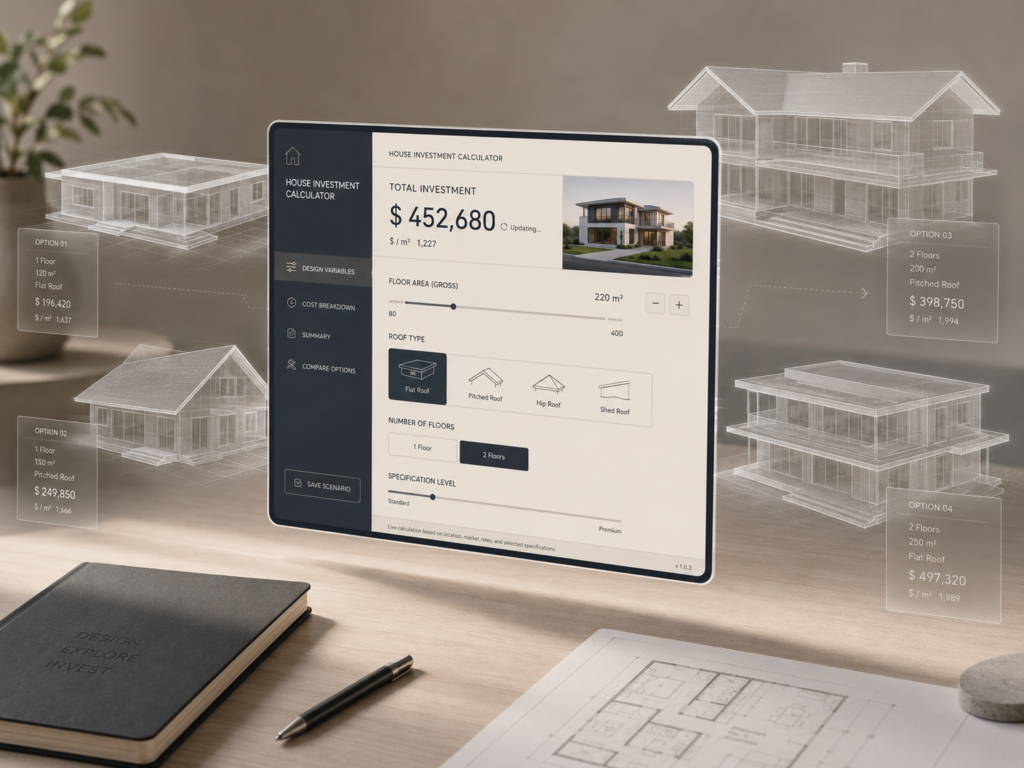
Detailed homebuilding investment estimate calculator: every decision costed in real time
Private homebuilders make life-defining decisions worth hundreds of thousands of euros – without a complete picture of what the project actually costs. Not because they don’t want to know, but because the tool that could show them hasn’t existed. Until now. LynxCraft as a part of Lynx Copilot introduces detailed homebuilding investment estimate!
Don’t expect your architect to give you a clear view of total project costs. Too many of those costs fall outside their scope – it’s not their domain, and it’s not what they’re paid for. Traditionally, private homebuilders piece together cost information in fragments:
• Your architect quotes their own documentation fees.
• Each contractor quotes their own line item – never the full picture.
• Google and other websites give you averages with no context.
The result: most private homebuilders make decisions throughout the entire project based on incomplete information.
The Lynx detailed homebuilding investment estimate – built into the Lynx copilot – is the first tool that changes this. For the first time, you have visibility into every cost, from the first idea to the final invoice.
The Lynx detailed homebuilding investment estimate is with you at every stage of building your home.
Phase 0: Research and planning – no cost of error
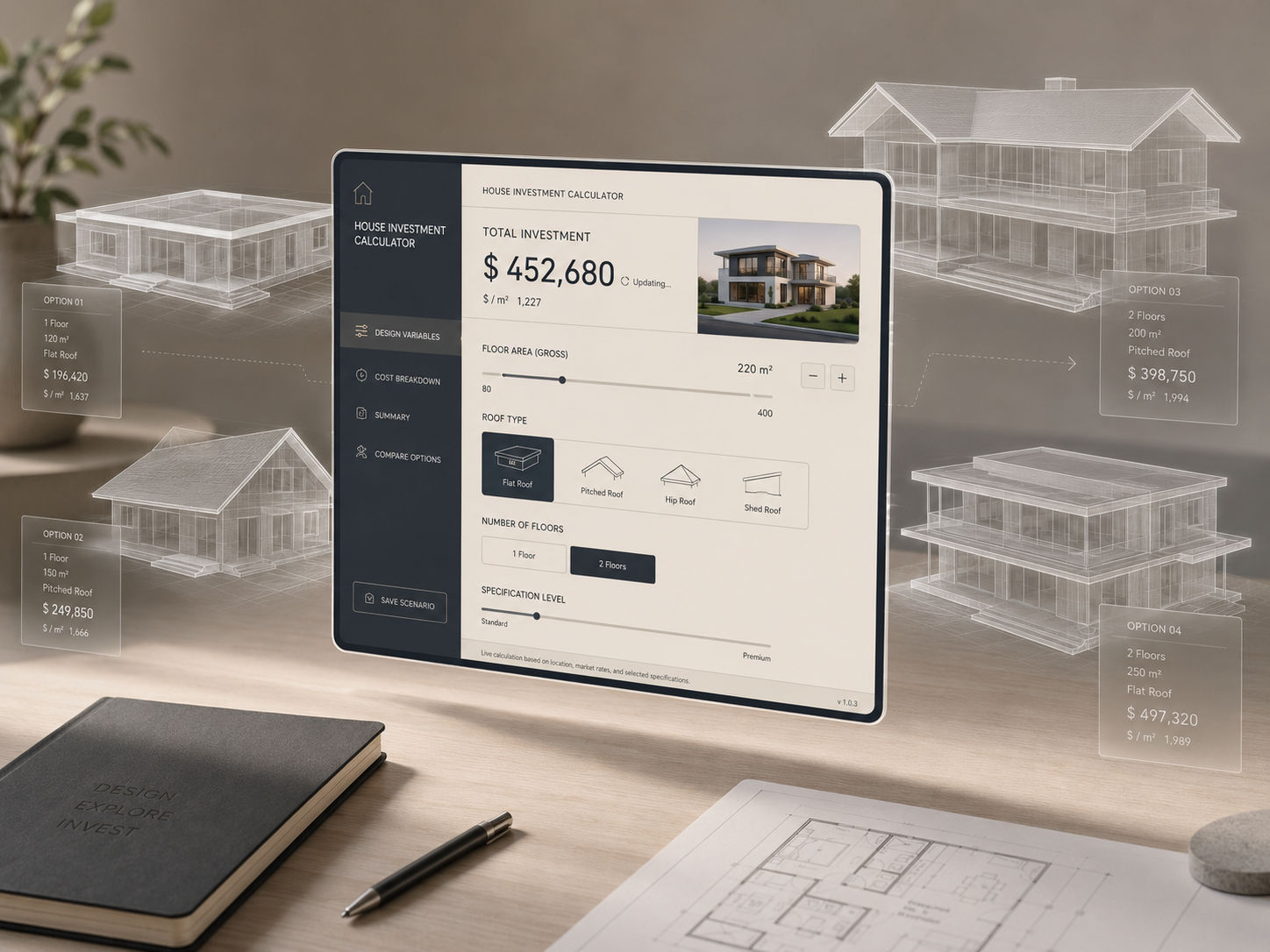
In Phase 0, you’re not designing your house yet. No floor plans, no façade details. This is the research phase – a guide to your home before serious design begins. The only thing that matters at this stage is defining the building’s external dimensions, so you can verify whether what you want is compatible with the constraints of your plot.
As you answer simple questions in the Lynx copilot, the system builds a personalised guide to your home in the background – and the calculator is a central part of it. Lynx detailed homebuilding investment estimate assembles costs based on your choices and preferences, in real time. Every parameter change – larger floor area, pitched or flat roof, an extra bathroom – is immediately reflected in the total investment estimate.
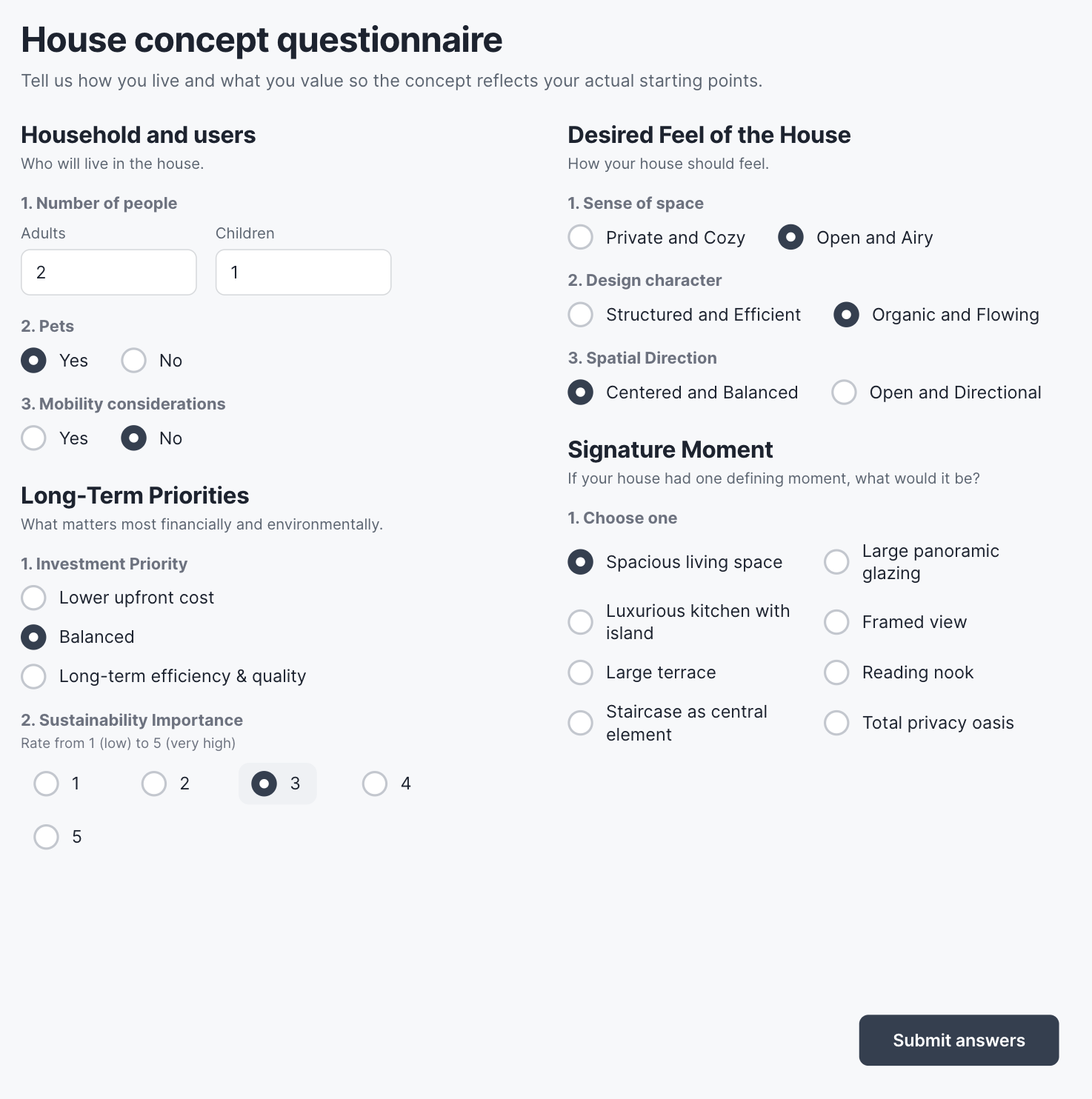
This is not a small improvement in homebuidling/ selfbuild experience. In a conventional process, every iteration takes time and costs money – every change requires the architect’s time, new drawings, a new estimate. With the Lynx detailed homebuilding investment estimate, the cost of iteration is zero. Smaller floor plan, different roof, one storey or two – you explore each option in minutes, before anything is committed to paper.
“What can I actually afford? Where exactly does my budget run out – at floor area, or at build quality?”
You get answers to these questions before you commit. Not three months and several thousand euros in, when changing course is expensive.
Phase 1: Concept design – a specific number for every decision
Once your wishes are aligned with your plot and budget in Phase 0, the Lynx detailed homebuilding investment estimate goes beyond a single total. It shows a broken-down investment estimate across six categories and more than twenty-five line items – from design fees to land registry costs.
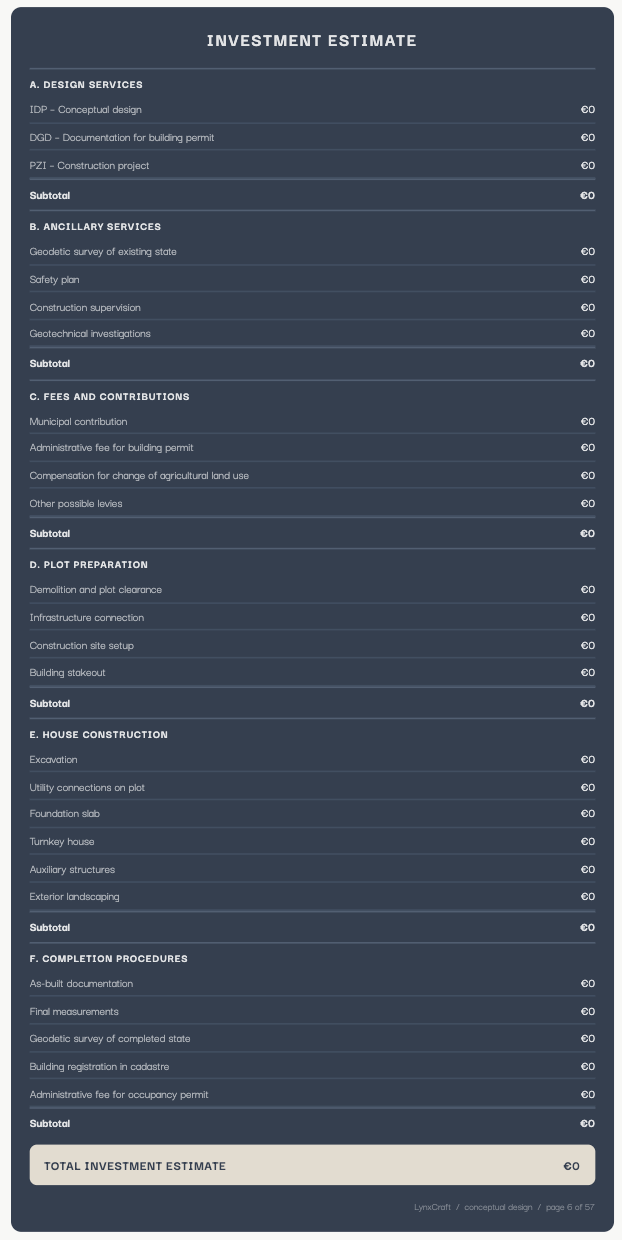
Each line item is explained: what it covers, why it arises, and what factors affect its size. This isn’t a rough-order estimate. It’s a document that covers the entire project – not just construction.
In the concept design phase, when you and your architect begin working on the actual appearance of your future home, the cost structure from Phase 0 becomes the architect’s reference. Architects typically don’t have visibility into the full cost of building a home – which is why misalignments between what an investor can spend and what the architect’s design actually costs are common. Architects regularly deliver projects that significantly exceed the investor’s financial capacity, simply because the data wasn’t available. As an investor, you often don’t realise this either – because the concept design is prepared before you understand the cost structure of the full project.
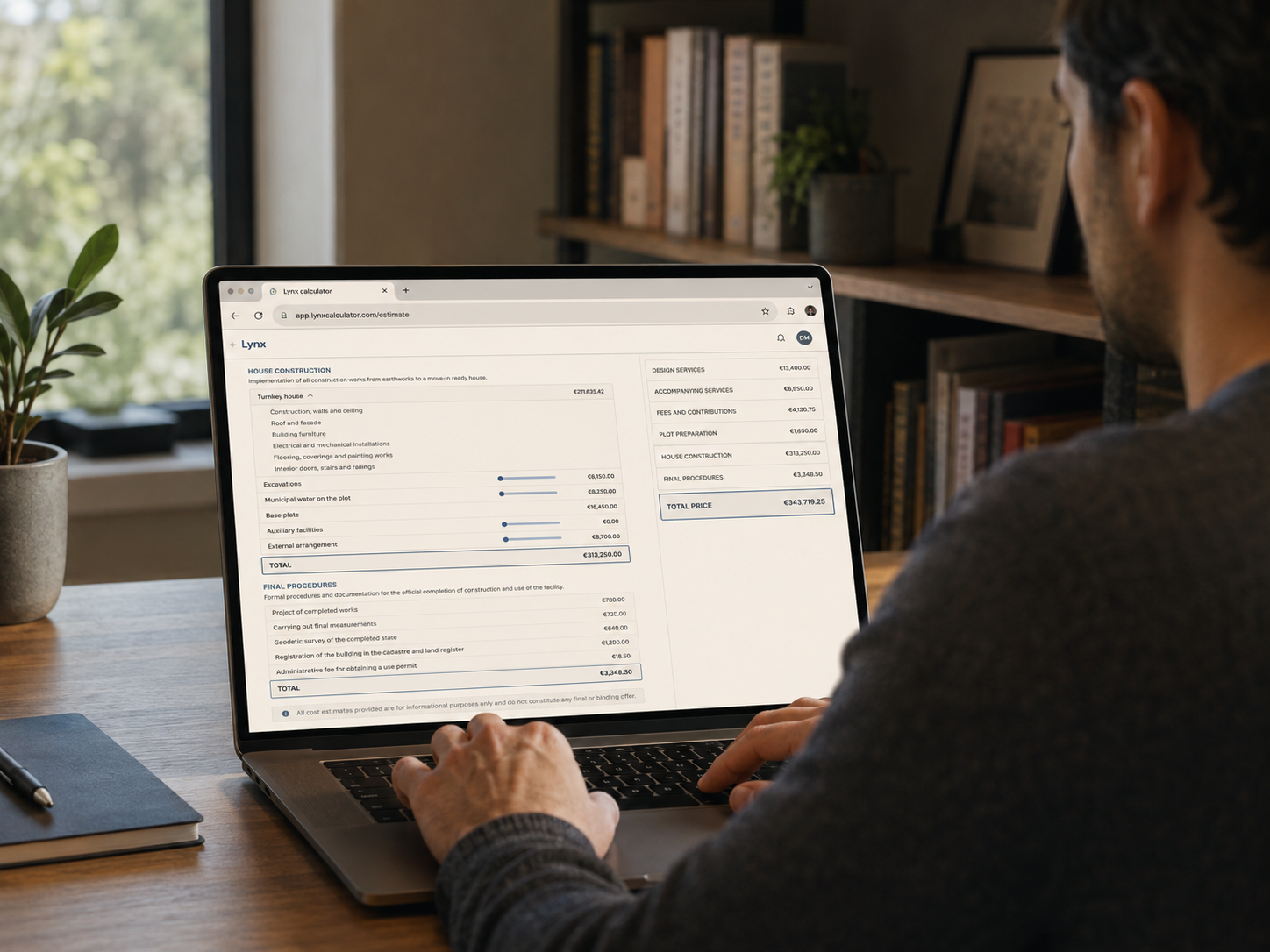
Only when you see the total across all six categories do you know what your project actually costs. Not just the build – the whole project.
The result is a communication gap: both sides are operating with too little data, and both are in the wrong. With the Lynx detailed homebuilding investment estimate, that gap closes. Both investor and architect access the same data, in real time. No guesswork, no miss-communication.
Phase 2: Building permit – budget control as conditions come in
Once the Lynx concept design is complete – verified against your wishes, plot, and budget by your Lynx architect – the next step is the building permit. This is the moment your Phase 1 design first encounters official conditions: permit-granting authorities, public agencies, and infrastructure providers.
Your Lynx architect has already checked all publicly available plot restrictions during the concept phase – using Lynx copilot data that has been part of the project from the start. The project therefore enters the DGD phase already aligned with basic spatial planning rules. What depends on the specific conditions set by individual authorities is confirmed with certainty only now.
Adjustments are common at this stage. Authority conditions can require changes to the design – a different building position, an additional connection point, a revised setback, a different technical solution. Each of these changes has a financial cost. That said, 99% of Lynx copilot projects avoid these changes, because the concept design is prepared with spatial constraints in mind from the outset.
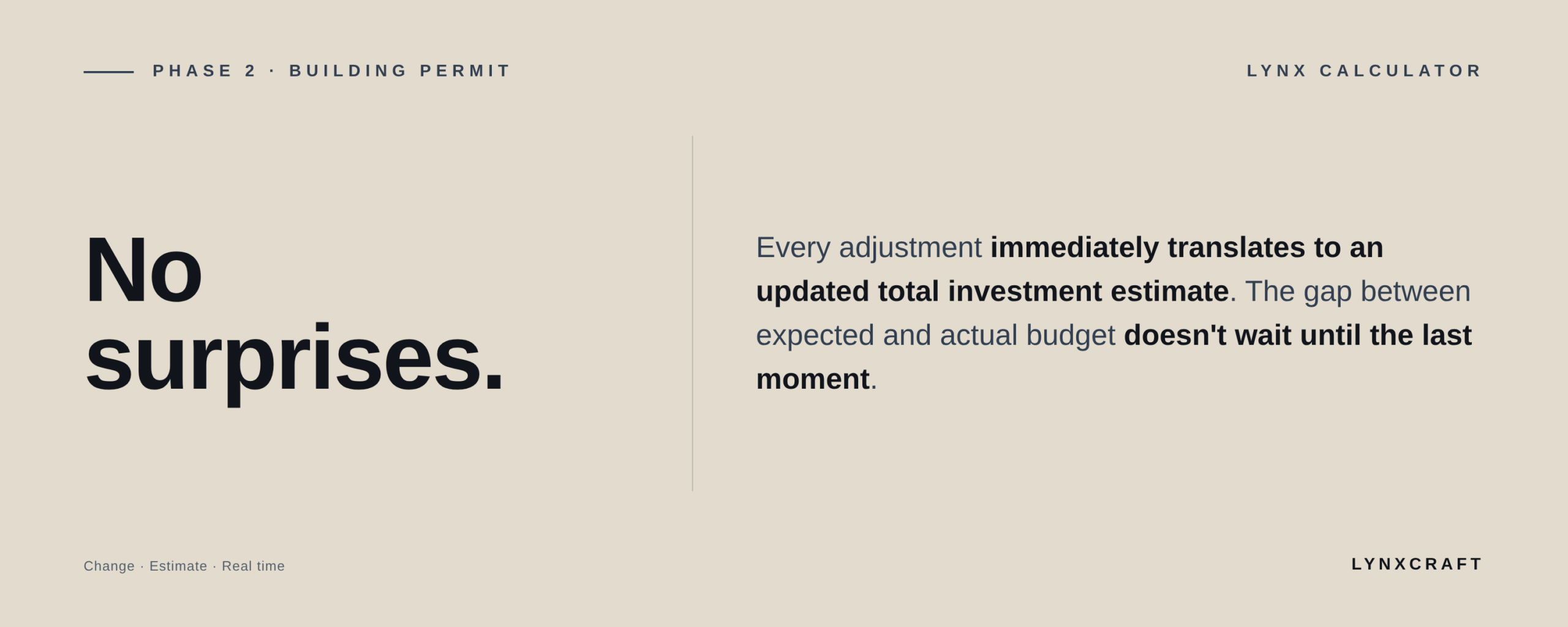
Here, the Lynx detailed homebuilding investment estimate acts as a live reference. Every adjustment made during permit documentation preparation is immediately reflected in an updated detailed homebuilding investment estimate. You can see whether the project is still within budget after incorporating the authority’s conditions – in real time, not three weeks later when the architect sends a revised quote.
No surprises.
Investor and architect stay aligned on the same data throughout the DGD phase. Every change is visible immediately.
Phase 3: Selecting contractors – seeing what the quote doesn’t show
When contractor quotes arrive, they look similar at first glance. The differences that actually matter are in the details – missing line items, hidden charges, differing definitions of what’s “included”. Two quotes with the same total can represent entirely different scopes of work. The gap surfaces during construction, where you pay for it as an extra. This is where the Lynx AI project manager takes over. Every quote received is broken down line by line and placed against your Lynx detailed homebuilding investment estimate.
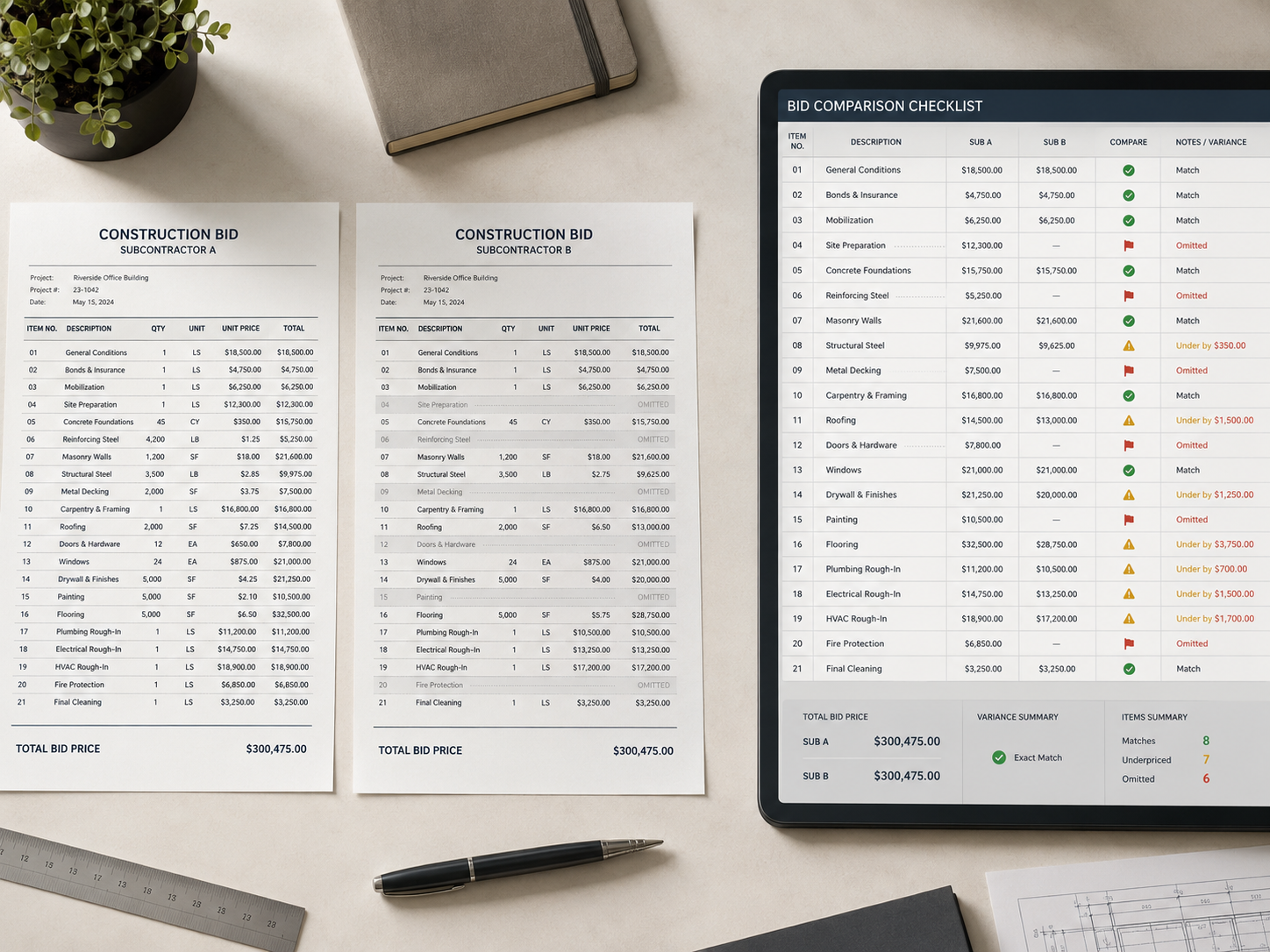
Through Phases 0, 1, and 2, the calculator has evolved into a detailed schedule of everything planned for construction – from excavation and utility connections to the foundation slab, outbuildings, and landscaping. It includes the materials and technologies chosen with your architect, and an independent cost estimate for each line item, derived from your decisions and plot data – not from the contractor’s own calculation.
The comparison checks two things simultaneously. Does the quote cover the full scope of work? Items the contractor has not included stand out immediately. Are the prices within reasonable range? Prices that deviate significantly from the estimate stand out too – upward because you’re overpaying, downward because a low price often means the difference arrives as an extra during construction.
You know exactly which quote is genuinely the best – not just the lowest on the cover page. The conversation with the contractor starts from your confirmed, detailed scope of work. Not from their explanation of what’s “normally included.”
Phase 4: During construction – is “unforeseen work” actually unforeseen?
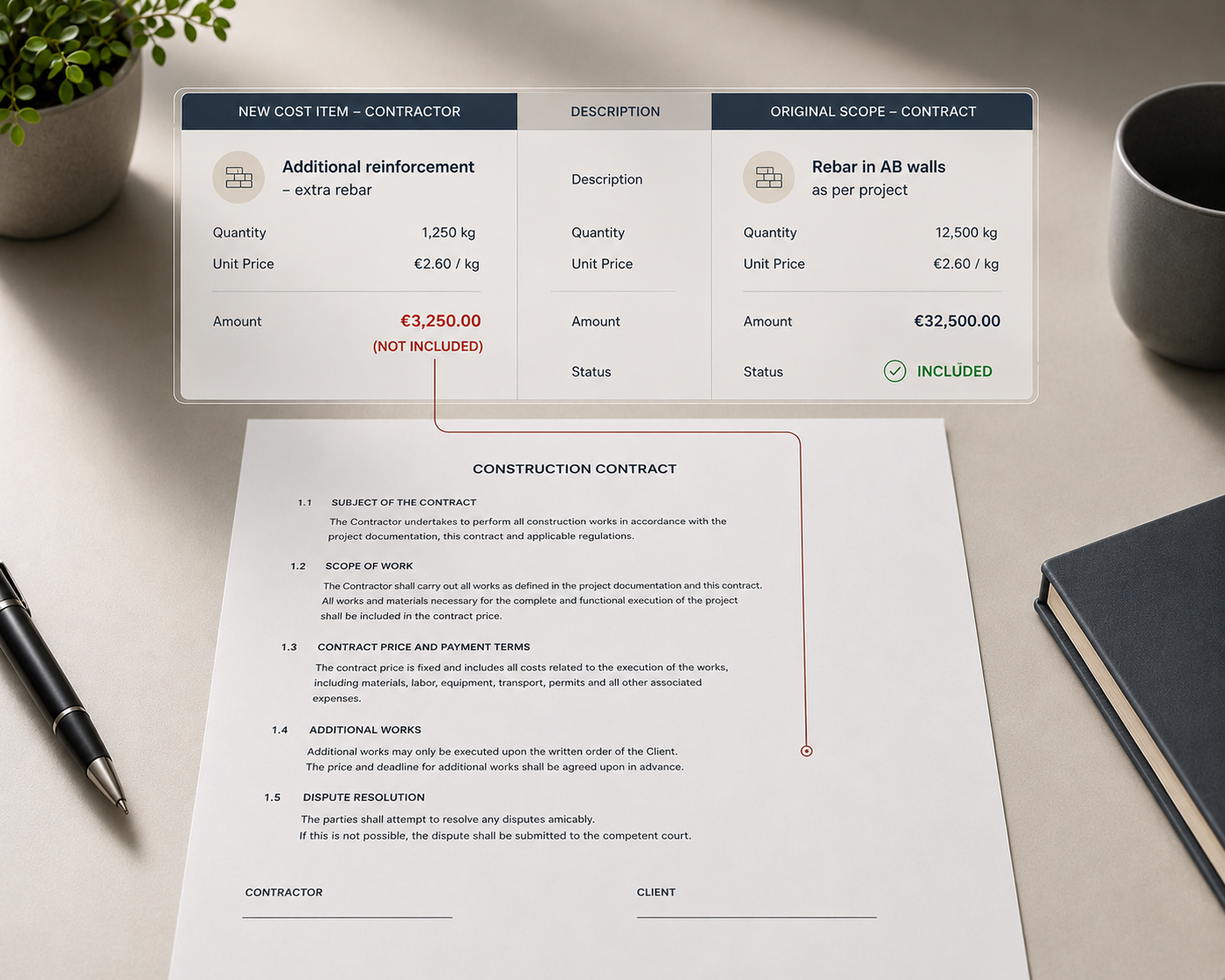
Every homebuilder hears the phrase “unforeseen work” at some point during construction. The contractor presents an additional cost not covered in the contract and frames it as a logical consequence of something that changed in the project. The question is always the same: is this cost justified, or should it have been included in the contract you signed?
The Lynx AI project manager handles this. Every new cost is compared against the agreement on which the contract was based – your Lynx calculator.
Through Phases 0, 1, 2, and 3, the calculator established what would be built, what the scope of work was, what it would cost, and who would carry it out. In Phase 4, it takes on a new role: a reference point for every new piece of information the project generates during construction – an archaeological find, a change in ground conditions, a regulatory update, a situation revealed after excavation. Each of these is fed back into the detailed investment estiate, which shows which costs are genuinely the result of a new circumstance and which should have been included from the start.
The comparison checks two things simultaneously. Is this a genuinely unforeseen situation? The Lynx AI project manager shows which new piece of information triggered the cost, and why it could not have been anticipated in earlier phases. Should this cost be covered by the existing contract? That too is shown – with reference to the specific contract clause that should cover it.
Negotiations with the contractor start from data that both sides have seen from the beginning of the project. Not from intuition.
The practical result
The Lynx detailed homebuilding investment estimate is the only tool that gives a private homebuilder a complete financial picture at every stage of the project – not just the section your architect or contractor can explain.
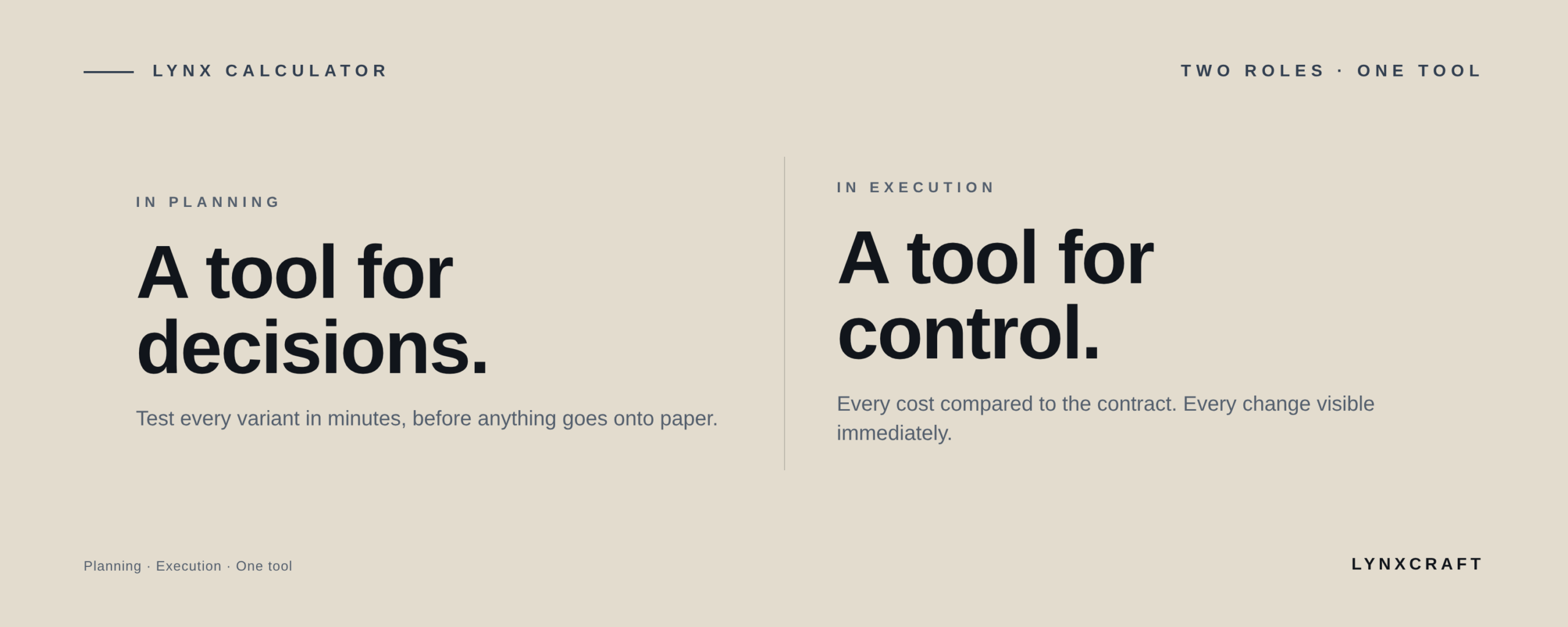
In the planning and research phases, it’s a decision-making tool. During construction, it’s a control mechanism.
What was previously available only to experienced professional investors with their own teams of architects, project managers, and financial advisors is now available to you – for building your own home!

